
The Emerging Social Cohesion Roadmap
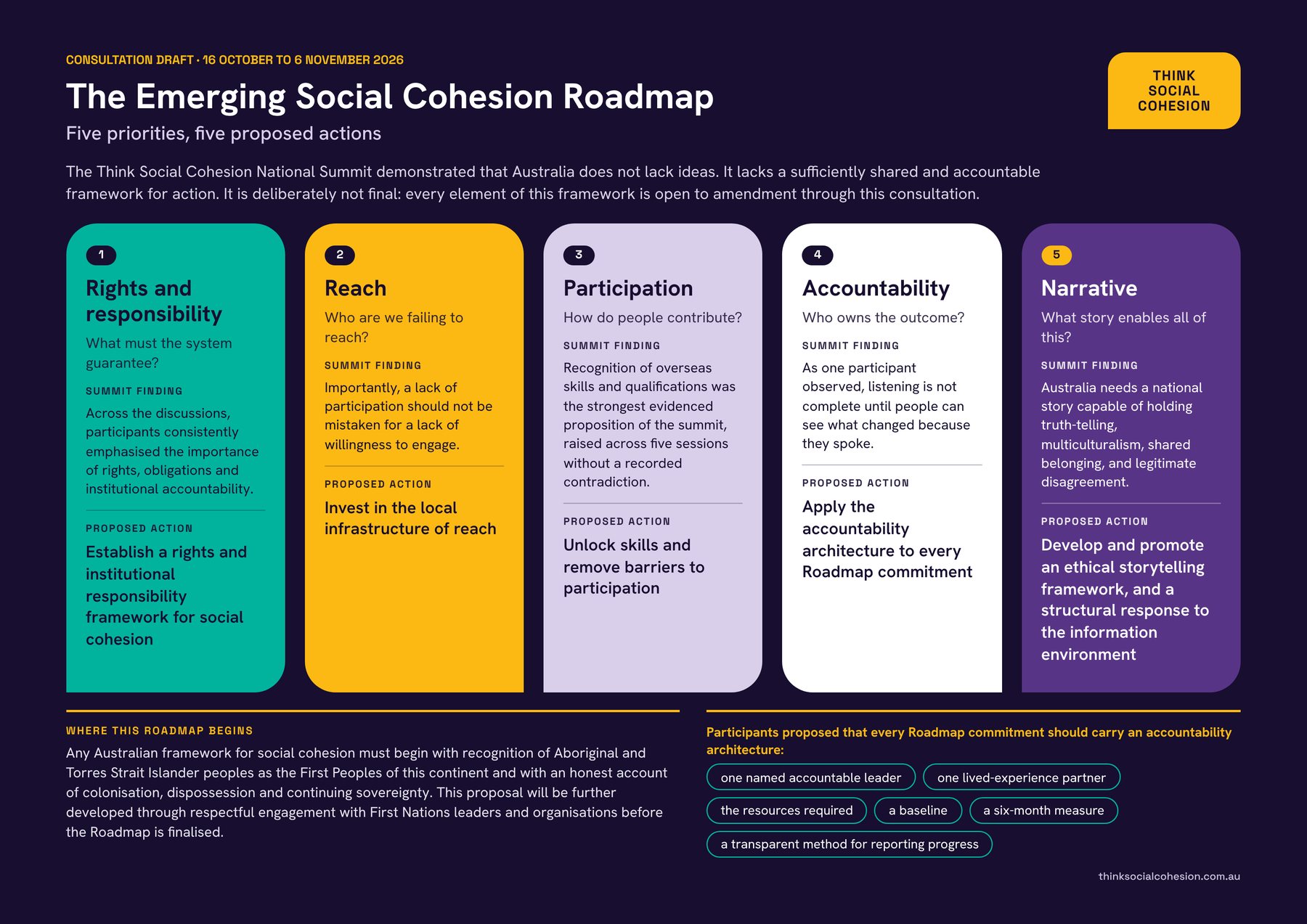
Released for consultation by SydWest, SSI and SCOA. This consultation draft develops the five emerging priorities identified through the Summit and the Summit Report, and proposes one action under each. Neither the priorities nor the actions have been presented as fully endorsed or ratified by the Summit. They are now being returned for further consideration and amendment. It is deliberately not final: every element of this framework is open to amendment through this consultation.
The Think Social Cohesion National Summit demonstrated that Australia does not lack ideas. It lacks a sufficiently shared and accountable framework for action.
On 28 July 2026, 160 invited leaders spent a full day in Parramatta examining the conditions that strengthen or weaken social cohesion. While the discussions did not result in agreement on every issue, five clear priorities emerged consistently across keynote presentations, panel discussions and participant contributions. These priorities provide a shared foundation for action, while recognising that important differences of perspective remain and require further consideration. Those five priorities are set out below as an emerging framework, each followed by one proposed action and the questions we are now asking you to test.
Each proposed action carries a note on its origins: a finding of the summit, a proposition the convening partners have developed since, or both. The Summit Report stands as the record of the day; this Roadmap sets out how we propose to progress the actions. Each action will be taken forward as a stream of work, and organisations will be invited to contribute.
Released for consultation by SydWest, SSI and SCOA. This consultation draft develops the five emerging priorities identified through the Summit and the Summit Report, and proposes one action under each. Neither the priorities nor the actions have been presented as fully endorsed or ratified by the Summit. They are now being returned for further consideration and amendment. It is deliberately not final: every element of this framework is open to amendment through this consultation.
The Think Social Cohesion National Summit demonstrated that Australia does not lack ideas. It lacks a sufficiently shared and accountable framework for action.
On 28 July 2026, 160 invited leaders spent a full day in Parramatta examining the conditions that strengthen or weaken social cohesion. While the discussions did not result in agreement on every issue, five clear priorities emerged consistently across keynote presentations, panel discussions and participant contributions. These priorities provide a shared foundation for action, while recognising that important differences of perspective remain and require further consideration. Those five priorities are set out below as an emerging framework, each followed by one proposed action and the questions we are now asking you to test.
Each proposed action carries a note on its origins: a finding of the summit, a proposition the convening partners have developed since, or both. The Summit Report stands as the record of the day; this Roadmap sets out how we propose to progress the actions. Each action will be taken forward as a stream of work, and organisations will be invited to contribute.
Where this Roadmap begins
Since the summit, the convening partners have proposed that First Nations sovereignty and truth-telling should sit within the conceptual foundation of this Roadmap, rather than among the voices to be added through consultation. The summit itself recorded that First Nations knowledge and leadership needed far more attention than they received on the day. The proposition is set out here for testing.
Any Australian framework for social cohesion must begin with recognition of Aboriginal and Torres Strait Islander peoples as the First Peoples of this continent and with an honest account of colonisation, dispossession and continuing sovereignty. Belonging cannot be built on historical amnesia. Truth-telling, self-determination and respectful relationships between First Nations peoples and all those who have subsequently made their lives here are foundational to a shared national future.
This proposal will be further developed through respectful engagement with First Nations leaders and organisations before the Roadmap is finalised. Establishing a meaningful governance partnership requires time, trust and genuine collaboration, and cannot be achieved through a short consultation process. The Roadmap will identify the development of this partnership as an early implementation priority.
Source: proposition developed by the convening partners since the summit.
1 Rights and responsibility
What must the system guarantee?
Social cohesion cannot rest on goodwill, aspiration or generic statements of values alone. Across the discussions, participants consistently emphasised the importance of rights, obligations and institutional accountability. This included calls for stronger legal and rights-based protections, and for employers to have a positive duty to prevent racism, rather than acting only after harm has occurred. The emerging proposition is that a duty bearer should be named for every commitment, rather than obligations resting with the people who experience the harm.
The summit did not suggest that legislation alone creates cohesion. One contribution explicitly challenged a predominantly legislative response. The direction is not law instead of relationships, but a stronger rights foundation accompanied by the social and institutional conditions that enable those rights to be experienced in practice.
Establish a rights and institutional responsibility framework for social cohesion. Name the duty bearer for each obligation, and examine the case for a positive duty to prevent racial discrimination across employers and other institutions. The form of any wider rights instrument remains open. Any legislative response should be developed alongside the relational and place-based approaches the summit identified, not as a substitute for them.
Source: summit finding (Summit Report, sections 3.1 and 6.1). The summit called for some form of legal or rights-based instrument and did not settle its form.
- Does this reflect the discussion? What form should a rights instrument take, and where should positive duties apply?
2 Reach
Who are we failing to reach?
Social cohesion initiatives often reach people who are already willing and able to engage. A more challenging question, raised independently across four sessions, is how to connect with those who remain outside the reach of existing institutions and programs: people who have disengaged, those for whom existing approaches have not worked, and those who have never been meaningfully reached. The Summit highlighted the importance of distinguishing between these experiences, recognising that they reflect different barriers to participation and require different responses. Importantly, a lack of participation should not be mistaken for a lack of willingness to engage.
The infrastructure of reach is local. Local government, neighbourhood organisations, libraries, schools, workplaces, local media, third spaces and place-based mechanisms such as micro-grants are where people encounter institutions and one another. For people establishing their lives in Australia, settlement infrastructure provides the bridge to communities, services and institutions. Designing for reach means institutions changing where, how and through whom they engage.
Invest in the local infrastructure of reach. Strengthen local government, neighbourhood organisations, libraries, schools, workplaces and third spaces, while requiring institutions to examine and strengthen where, how and through whom they engage, with particular attention to people not reached through existing networks.
Source: summit finding (Summit Report, sections 3.2 and 6.2).
- Who is being missed in your community or sector, and what would reach them?
- What local infrastructure should the Roadmap prioritise for investment?
3 Participation
How do people contribute?
Recognition of overseas skills and qualifications was the strongest evidenced proposition of the summit, raised across five sessions without a recorded contradiction. When capability cannot be converted into opportunity, the consequences impact economic security, independence, confidence and the ability to participate fully in Australian life. The summit pointed towards pathways rather than services: systems designed around people's progression, agency and capacity to contribute, including through employment and entrepreneurship.
Participation is broader than economic participation. It includes community and civic leadership and genuine opportunities to shape the institutions and decisions that affect people's lives. The Summit also acknowledged an important gap in the discussions: the material conditions that shape social cohesion, including housing, wages, insecure work and cost-of-living pressures, received comparatively limited attention. These issues will require more deliberate consideration as the Roadmap develops.
Unlock skills and remove barriers to participation. Begin with recognition of overseas skills and qualifications, build pathways into civic and community leadership as well as employment, and examine the material conditions that restrict participation.
Source: summit finding (Summit Report, sections 3.3 and 6.3).
- What would most quickly convert existing capability into participation?
- How should material and economic conditions be brought into this framework?
4 Accountability
Who owns the outcome?
Across five sessions, participants expressed concern that consultation too often fails to translate into meaningful action. People contribute their time, experiences and expertise, yet rarely see how their contributions influence decisions or lead to change. The Summit highlighted the need to move beyond meaningful consultation to genuine accountability: who takes responsibility for acting on what is heard, and how are those who contributed able to see the outcomes? As one participant observed, listening is not complete until people can see what changed because they spoke.
The closing session gave this principle its most concrete form. Participants proposed that every Roadmap commitment should carry an accountability architecture:
- one named accountable leader
- one lived-experience partner
- the resources required
- a baseline
- a six-month measure
- a transparent method for reporting progress.
The proposal is that this architecture be applied to every commitment made in the final Roadmap. A commitment without ownership, resources and measurement is an intention, not a roadmap.
Apply the accountability architecture to every Roadmap commitment. Each commitment carries a named accountable leader, a lived-experience partner, the resources required, a baseline, a measure of progress and a transparent method of reporting, and participants are told what changed because they contributed.
Source: summit finding from the closing session (Summit Report, sections 3.4 and 6.4). The positive duty to prevent racial discrimination sits under Rights and responsibility, where the summit placed it.
- Is this the right accountability model, and what would make it enforceable rather than aspirational?
5 Narrative
What story enables all of this?
Australia needs a national story capable of holding truth-telling, multiculturalism, shared belonging, and legitimate disagreement. The way we speak about diversity shapes public understanding, policy and belonging, and political and institutional leadership helps set the boundaries on what public discourse legitimises.
The summit moved beyond a call for better stories. It identified structural features of the information environment, including algorithmic optimisation towards outrage, commercial incentives and platform design that can pit communities against one another, and it surfaced digital duty of care as one possible structural response. It also produced one immediately practical proposition: an ethical storytelling protocol built on informed and continuing consent, cultural safety, co-authorship, fair recognition and the right to review or withdraw, which organisations can begin applying without waiting for legislation or funding.
Develop and promote an ethical storytelling framework, and a structural response to the information environment. Build the framework on informed and continuing consent, cultural safety, co-authorship, fair recognition and the right to review or withdraw. Alongside it, develop a structural response covering platform incentives, algorithmic amplification and media responsibility, together with a tested public narrative of belonging and contribution.
Source: summit finding (Summit Report, sections 3.5 and 6.5).
- Should the Roadmap pursue structural responses to the information environment, and which ones?
- Would your organisation support or adopt an ethical storytelling protocol based on these principles?
- How should the Roadmap protect safety and dignity while preserving space for legitimate disagreement and difficult conversations?
Two propositions to hold together
Across the Summit, two important and closely related principles emerged, highlighting a tension that must be carefully navigated. Social cohesion belongs to all Australians: it is a whole-of-society responsibility and must not be framed as something migrant and multicultural communities are responsible for producing. At the same time, multiculturalism is a defining national strength that should be embedded more deeply within Australia's systems, institutions and public life. The work ahead is to hold both: recognising and strengthening Australia's multicultural character while making clear that responsibility for cohesion cannot be placed on multicultural communities alone.
Broadening this consultation
The Summit provided an important foundation for discussion, while recognising that a single day could not capture the full range of perspectives and experiences that shape social cohesion in Australia. Several areas received limited attention or were not adequately represented, including First Nations knowledge and leadership, people with disability, young people, regional and rural communities, smaller faith communities, material and economic conditions, and approaches to evidence and measurement.
The consultation process seeks to address these gaps through targeted written contributions and engagement with people and organisations whose perspectives were underrepresented, including dedicated engagement with First Nations leaders and organisations. We particularly encourage contributions from these groups to ensure the final Roadmap reflects a broader range of experiences, priorities and expertise, and is strengthened by voices that were not sufficiently heard on the day.
What we are asking you
- Does each proposed action reflect the problem? What is missing or overstated?
- Which actions matter most to the people your organisation works with?
- What should change before the Roadmap is finalised?
- Whose perspectives does the next stage need to hear?
- Optional: would your organisation like to contribute to one of the five streams of work, and which one?
Consultation opens with a live session at the FECCA conference on 16 October 2026, where the five priorities and proposed actions are put to the room as five streams and tested through discussion and the consultation survey. Responses made in the room are submissions. The survey then goes to Summit participants and the convening partners’ networks on 19 October 2026 and closes 6 November 2026. Responses can be made through the consultation survey at thinksocialcohesion.com.au, which asks the questions above. A working group of the three convening partners and the Summit Architect will review every response. Every substantive point will be logged in a feedback register and given a documented outcome: adopted, amended, or not adopted, with reasons.
Every respondent will receive the ‘what we heard, what changed’ report, showing how consultation input shaped the final Roadmap, and the final Roadmap will be provided to the Royal Commission on Antisemitism and Social Cohesion and to government. The Summit originally proposed a six-month accountability review, scheduled for 28 January 2027. However, as the Roadmap is being finalised later than anticipated, a review at that point would provide insufficient time for commitments to be implemented and progress to be meaningfully assessed. The review will therefore take place six months after publication of the final Roadmap, with progress against commitments assessed and publicly reported through the Roadmap’s accountability framework. This will provide an important measure of whether the commitments made are translating into meaningful action and tangible outcomes.